Understanding the difference between ADHD and Autism Spectrum Disorder (ASD) can help parents, teachers and caregivers identify a child’s needs and seek appropriate support at the right time. Although both conditions can affect communication, learning, behaviour, attention and social interaction, they are different neurodevelopmental conditions.
What is ADHD?
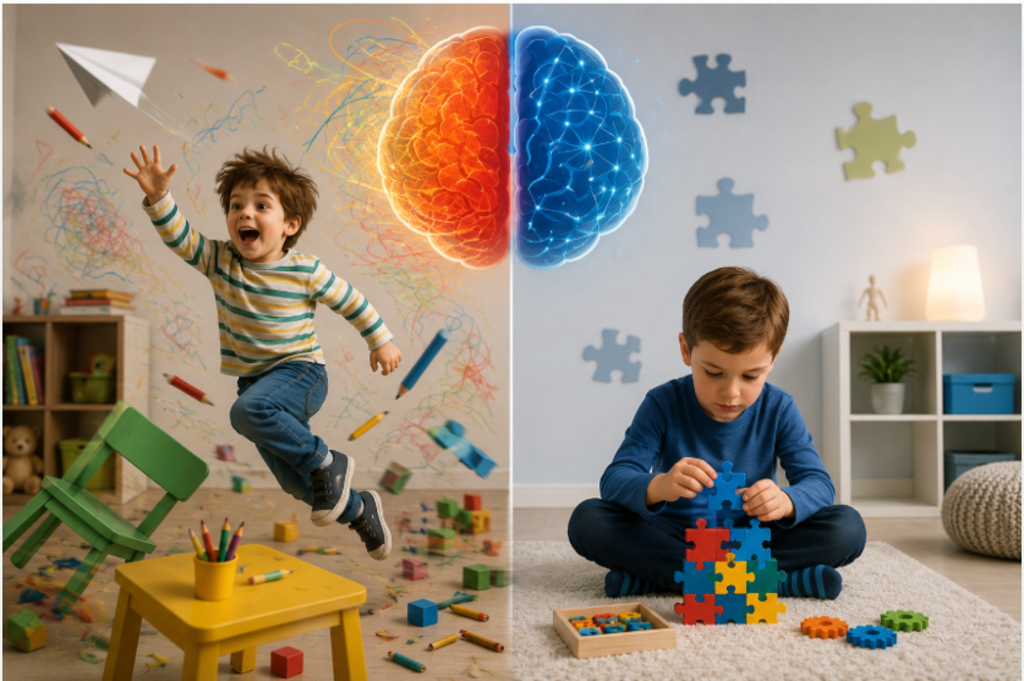
Attention-Deficit/Hyperactivity Disorder (ADHD) is a neurodevelopmental condition that primarily affects attention, impulse control, activity level and executive functioning. Children with ADHD may have difficulty sitting for long periods, waiting for their turn, following instructions, completing tasks, controlling impulses or maintaining attention.
Common features of ADHD
- Difficulty sustaining attention
- Easily distracted
- Forgetfulness
- Difficulty completing tasks
- Difficulty sitting in one place for a long time
- Interrupting or talking excessively
- Acting without thinking
- Difficulty waiting for their turn
- Emotional impulsivity or difficulty managing frustration
- Frequently changing from one activity to another
Importantly, ADHD does not mean that a child is lazy, careless or intentionally disobedient. These behaviours are often related to difficulties with attention and self-regulation.
What is Autism Spectrum Disorder?
Autism Spectrum Disorder (ASD) is a neurodevelopmental condition primarily associated with differences in social communication and social interaction, together with restricted or repetitive patterns of behaviour, interests or activities.Autistic children may communicate and interact differently from other children. The way autism presents can vary considerably from one child to another.
Common Features of ASD
- Difficulty with social communication
- Reduced or inconsistent eye contact
- Difficulty understanding social cues
- Delayed or unusual language development
- Repeating words or phrases (echolalia)
- Strong preference for routines
- Highly focused or intense interests
- Sensory sensitivities to sounds, lights, textures, smells or movement
- Difficulty with pretend or imaginative play
- Preference for playing alone in some children
Autism is called a spectrum because children can have very different strengths, abilities, communication styles, and support needs.
ADHD vs ASD: Key Differences
| Area | ADHD | Autism Spectrum Disorder (ASD) |
| Main difficulty | Attention, impulse control and self-regulation | Social communication and restricted/repetitive patterns |
| Attention | May have difficulty sustaining attention, particularly for less-interesting tasks | May have intense, prolonged attention toward preferred interests |
| Activity level | Hyperactivity and restlessness may be prominent | Activity level varies; repetitive movement may occur |
| Social interaction | May want to interact but interrupt, talk excessively or struggle with turn-taking | May have difficulty understanding or navigating social interaction |
| Eye contact | Usually not a core diagnostic feature | Reduced or atypical eye contact may occur |
| Communication | Speech is generally developed, although conversation may be impulsive or poorly regulated | Language may be delayed, atypical, repetitive or socially difficult to use |
| Repetitive behaviour | Not a core feature of ADHD | A core feature of ASD |
| Need for routine | May struggle with routines because of organization and attention difficulties | May strongly prefer routines and predictability |
| Sensory differences | Can occur but are not central to diagnosis | Sensory differences are common and included in diagnostic criteria |
| Interests | Interests may change frequently | Interests may be unusually intense or restricted |
| Impulsivity | Common | Can occur, but is not a defining feature |
| Emotional regulation | Frustration and emotional impulsivity can be prominent | Emotional distress may occur, especially with sensory overload or changes in routine |
A Simple Example
Consider a child who frequently leaves their seat during classroom activities.
A child with ADHD may leave their seat because they are restless, distracted, impulsive or finding it difficult to sustain attention.
An autistic child may leave their seat because of sensory discomfort, difficulty understanding the activity, anxiety caused by a change in routine, or a need to engage in a preferred repetitive activity.
The same behaviour can have different underlying reasons.This is why professionals should look beyond the behaviour itself and understand why the behaviour is occurring.
Can a Child Have Both ADHD and ASD?
Yes. ADHD and ASD can occur together. Some children may show characteristics of both conditions.
For example, a child may:
- Have difficulty maintaining attention
- Be highly active and impulsive
- Have difficulty with social communication
- Show repetitive behaviours
- Struggle with emotional regulation
- Have sensory sensitivities
- Have difficulty following classroom routines
When ADHD and ASD occur together, the child may require a more individualized intervention plan addressing attention, behaviour, communication, social skills, sensory needs, learning and daily functioning.
How Are ADHD and ASD Identified?
There is no single test that can identify ADHD or ASD in every child.
Assessment generally involves understanding the child’s:
- Developmental history
- Communication skills
- Social interaction
- Behaviour
- Attention and activity level
- Learning abilities
- Sensory responses
- Adaptive or daily living skills
- Behaviour across different environments
Parents, teachers, psychologists, developmental professionals and other appropriate specialists may contribute information to the assessment.
Early identification can help families understand the child’s strengths and challenges and plan appropriate intervention.
What Support Can Help?
Intervention should be individualized according to the child’s needs.
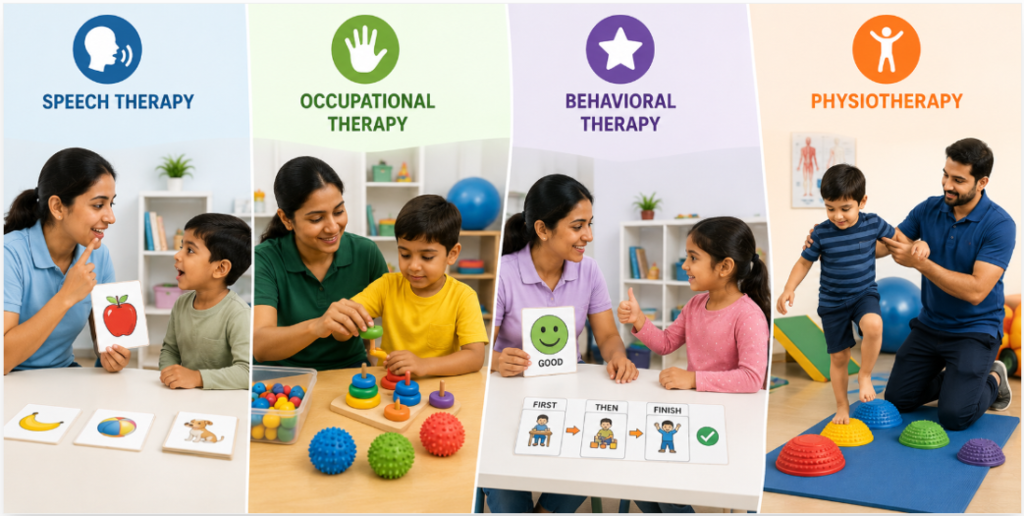
Depending on the child’s difficulties, support may include:
For ADHD
- Behavioural strategies
- Parent training
- Classroom accommodations
- Attention and executive-function strategies
- Structured routines
- Positive reinforcement
- Occupational therapy when appropriate
- Psychological support
- Medical management when recommended by a qualified medical professional
For ASD
- Speech and language therapy
- Occupational therapy
- Behavioural intervention
- Special education
- Social-communication training
- Play-based developmental intervention
- Parent-mediated strategies
- Sensory support when appropriate
- Support for adaptive and daily living skills
What Parents Should Remember
Every child is different. A child who is active, does not make consistent eye contact, has delayed speech or has difficulty sitting still does not automatically have ADHD or autism.
Similarly, having one or two characteristics associated with autism or ADHD does not by itself establish a diagnosis.
Parents should avoid comparing their child with other children and should seek a professional developmental assessment when concerns persist.
Early Support Makes a Difference
The goal of assessment is not simply to give a label. It is to understand how the child learns, communicates, behaves, interacts and functions in everyday life.
With appropriate support, structured intervention, family involvement and a positive environment, children with ADHD and/or ASD can develop meaningful skills and participate more successfully at home, school, and in the community.
Conclusion
ADHD is primarily associated with difficulties in attention, hyperactivity, impulsivity, and self-regulation, while ASD is primarily associated with differences in social communication and restricted or repetitive patterns of behaviour.
However, the two conditions can overlap, and some children may have both. Understanding the child—not just the diagnosis—is the first step toward effective support.